The challenge for AI is not just the availability of data. It is our ability to use data securely, responsibly and at scale.
Today, AI models are trained using a combination of publicly available information, licensed datasets and proprietary data. Access to large, high-quality datasets can provide a significant competitive advantage. Enterprises with the resources to acquire and process such data are often better positioned to develop specialised AI models, while smaller companies, startups and researchers and academia face barriers to entry. This in turn creates extensive monopoly and stifles competition and innovation where it is need more.
At the same time, enormous volumes of valuable data sit within enterprises, government departments, hospitals, insurance companies, financial institutions and research organisations.
This data holds immense potential for AI development. Healthcare data could support better diagnostic models, pharmaceutical research and drug discovery. Financial data could improve fraud detection and credit assessment. Data across sectors could enable new solutions that no single institution can build independently.
The challenge is that much of this data cannot be readily used for AI model training.
It may contain personally identifiable information (PII), commercially confidential information or intellectual property and trade secrets. Organisations also face legal, regulatory and reputational risks when sharing data.
Regulations such as Europe’s General Data Protection Regulation (GDPR) and India’s Digital Personal Data Protection (DPDP) Act establish obligations around the lawful processing and protection of personal data. For organisations holding sensitive information, the potential consequences of misuse or unauthorised disclosure can outweigh the perceived benefits of collaboration.
In the pharma world where molecular formula is the key for the business any form of collaboration becomes prohibitive.
This creates a fundamental challenge: how do we enable AI models to learn from valuable institutional data without compromising privacy, confidentiality or control?
DEPA for AI Training: Enabling Trusted Data Collaboration
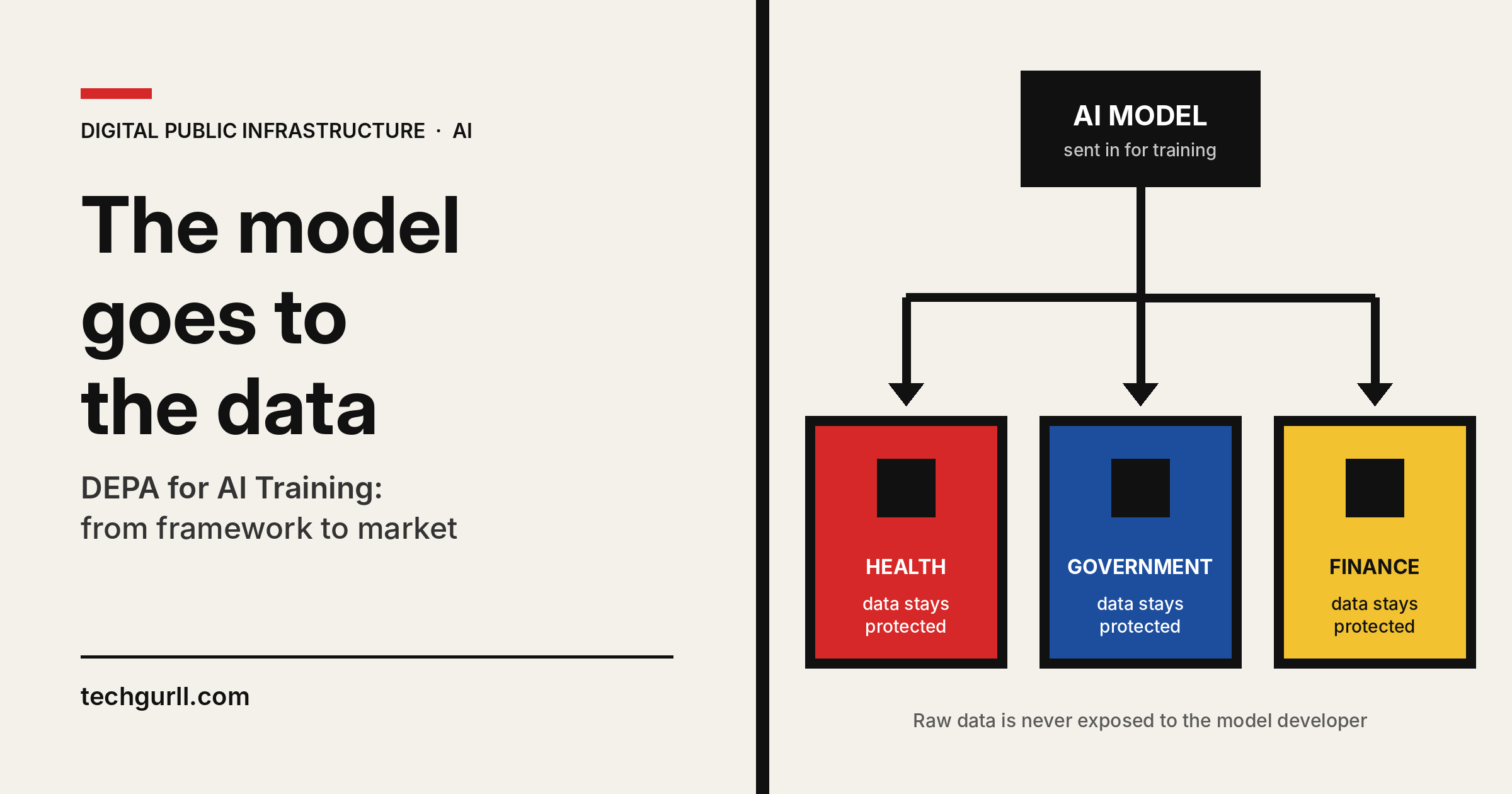
The Data Empowerment and Protection Architecture (DEPA) for AI Training proposes a techno-legal framework for secure, privacy-preserving and confidential multi-party data collaboration.
At its core, the framework seeks to enable AI models to learn from data held by multiple institutions without requiring those institutions to expose their raw datasets to model developers.
It brings together several technical and institutional mechanisms:
- Secure Data Environments and Confidential Computing: To enable controlled processing and model training while protecting sensitive data.
- Differential Privacy: To reduce the risk of disclosing information about individuals through trained models and analytical outputs.
- Electronic Contracts: To establish enforceable conditions governing the purpose, access and permitted use of data.
- Institutional Governance: To establish common rules, accountability, oversight and mechanisms for building trust among participating organisations.
Together, these mechanisms are designed to move beyond conventional bilateral data-sharing arrangements towards an interoperable and governed ecosystem for AI training.
Importantly, technology alone cannot establish lawful use or eliminate all risks. Appropriate governance, contractual arrangements, data protection practices and oversight remain essential.
Creating an Ecosystem, Not Just a Technology Framework
For DEPA to operate at scale, it requires an ecosystem of participants with clearly defined roles and incentives.
Training Data Providers (TDPs), such as hospitals, banks and government institutions, hold valuable datasets. Training Data Consumers (TDCs), including AI developers, researchers and enterprises, seek to use these datasets to develop and improve models.
Technology Service Providers (TSPs) enable the underlying infrastructure, including secure computing environments and related services. Data collaboratives can help bring institutions together, organise datasets and facilitate collaboration within specific sectors. Governance and trust institutions establish the standards and safeguards within which these participants operate.
But defining these roles is only the beginning.
Every participant must have a clear business reason to join and continue participating in the ecosystem.
Why should a hospital make its data available for AI training? What value does it receive in return? How does an AI developer gain access to useful data at a commercially viable cost? Who bears the cost of maintaining secure infrastructure, and how is that cost recovered?
The answer may involve commercial returns, benefit-sharing arrangements, access to improved AI models, better institutional outcomes or wider societal benefits.
Without viable incentives and sustainable business models, even a technically sound framework may struggle to achieve adoption.
From Framework to Market
The DEPA for AI Training Handbook, launched by the Ministry of Electronics and Information Technology (MeitY), establishes an important foundation for trusted data collaboration.
The next challenge is operationalization.
The focus now is on pilots that can demonstrate how this architecture works in real-world conditions, bringing together data providers, AI developers, technology partners and other ecosystem participants.
These pilots must test more than technological feasibility. They should help establish whether privacy safeguards work in practice, whether the resulting models deliver useful outcomes, whether institutions are willing to participate, and whether the economics can support sustained adoption.
A successful pilot should provide evidence for a repeatable model of collaboration, not simply demonstrate that a technology works.
Ultimately, DEPA’s potential lies in enabling institutions to collaborate on data that would otherwise remain inaccessible, creating opportunities for innovation while protecting the rights and interests of data holders and individuals.
The success of DPI for AI will not be determined by the frameworks we publish, but by the economic activity and institutional adoption they enable.


Leave a Reply